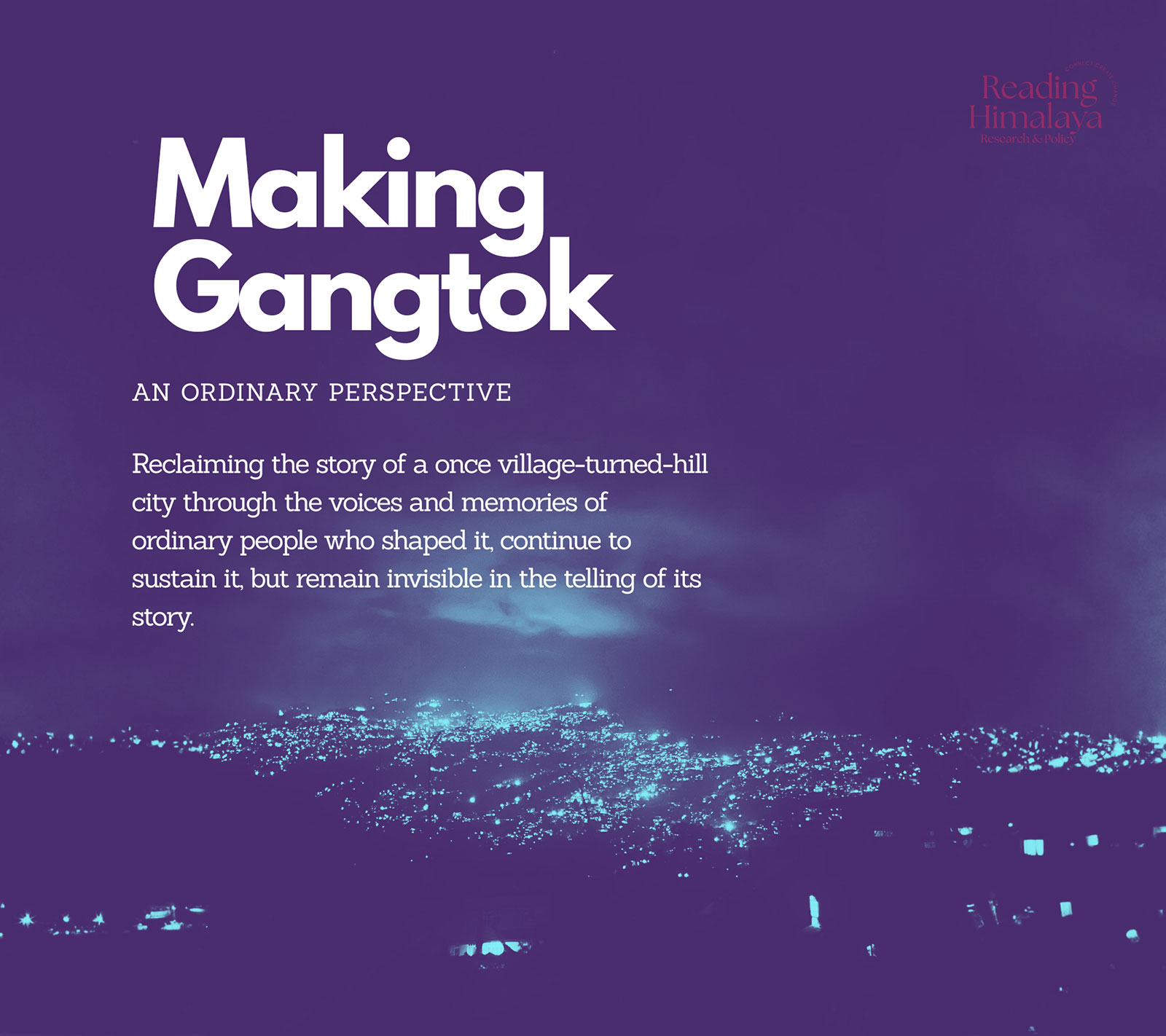
Gangtok is considered a model capital city of Northeast India— clean, manicured, well-managed, modern, and seemingly affluent. The transformation from a ‘remote’ frontier capital to a flourishing tourist destination has been the outcome of state policies over the last three decades. However, the groundwork for these transformations is rooted in Sikkim’s, and specifically the capital city Gangtok’s social and spatial history.
Gangtok was not always the capital of Sikkim. In fact, it is the fourth capital of Sikkim (Yuksom [1642-1670], Rabdentse [1670-1793], Tumlong [1793-1894]), established by Chogyal Thutob Namgyal in 1894.[1] Since its establishment, Gangtok continues to remain the centre of politics and administration in Sikkim, a vortex that draws in people, resources, cultures into a ‘dense’ space[2], a city still unsure of itself and what to preserve, protect or celebrate. This unclear vision of the future is perhaps linked to an incomplete and incomprehensive understanding of Gangtok’s past.
Official Sikkimese history largely bypasses the everyday lives and stories of ordinary people who were, and still are foundational to understanding and experiencing Gangtok. Much has been written about state formation, treaties and borders, the crumbling of kingdoms and the coming of democracy. Gangtok was central to all these transformations. And yet, the ordinary people who stood witness to all these major events, whose lives were invariably affected by them, are invisible in these accounts. As Gangtok changes further, those who sustain the city remain invisible. Making Gangtok, is a project that connects the past, present and the future through memories, narratives and personal renderings of certain moments and events. In doing so, the project hopes that in reclaiming our past, we will understand the present and the future better.
The project seeks to understand how history, ethnicity, class and gender map onto this city? Whose labour built and sustained Gangtok? How is Gangtok, both the city and experience made? The project focuses on different socio-temporal and spatial transformations starting in the early 1960s, and takes an interdisciplinary approach to look at various themes viz. livelihood, ecology, urbanisation etc. In seeking answers from multiple perspectives Making Gangtok aims to tell the story of a once village-turned-hill city through the voices and memories of those who have shaped it, continue to sustain it, but who perhaps still remain invisible.
Research Team:
Dr. Mona Chettri
Dr. Nirvan Pradhan
Dr. Rinan Shah
Dr. Anisa Bhutia
Dr. Lavomit Lepcha
[1] McKay, Alex. 2021. The Mandala Kingdom: A Political History of Sikkim. Rachna Books, Gangtok, Sikkim.
[2] McDuie-Ra, Duncan. 2026. ‘Gangtok’s Urban Atmospheres’. Sikkim Project, April 20.